If you’re concerned about security, read this guide first
Updated November 17, 2025| You may have heard that over the weekend of October 3rd and 4th there was a large protest in Male’, the capital of the Maldives. The story was widely covered by local media, but also major international media picked it up including the Associated Press, ABC News, and The Independent.
Shortly after this, the US State Department updated the Summary of its Travel Advisory for the Maldives. This prompted some rather alarmist headlines in several international publications. Unfortunately, many of those articles overestimated the significance of the State Department’s update. Critically, only a small piece of the State Department’s travel advice to the Maldives has changed, but not the general ‘alert level’ (which would have been much more significant change).
What has changed?
The State Department updated a tiny part of its Travel Advisory Summary. It did not change the Risk Indicators, nor the Travel Advisory Level. That means the Maldives remains on Travel Advisory Level 2 (out of 4 levels). Level 2 means ‘Exercise Increased Caution’. By comparison, Level 4 is ‘Avoid All Travel’. For context, the State Department also placed the United Kingdom, France and Germany on Level 2 Travel Advisories.
It’s worth understanding that all foreign offices have to outline the worst-case scenarios, and they have always recommended that travellers exercise a certain degree of caution in the Maldives. In short, the updated Summary of the State Department’s Travel Advisory only contains information about potential risks that numerous other foreign offices, including the UK Foreign Office, have listed for years.
It’s not unusual for the State Department to review or update advice; it’s part of its regular responsibilities. And protests and rallies are by no means uncommon in Male’. However, because the scale of the protest in Male’ was larger than usual, it attracted international media attention. And since that was then followed by more incendiary headlines about the State Department update, it left some holidaymakers and travel agents feeling nervous.
What happened overnight on Friday, October 3rd?
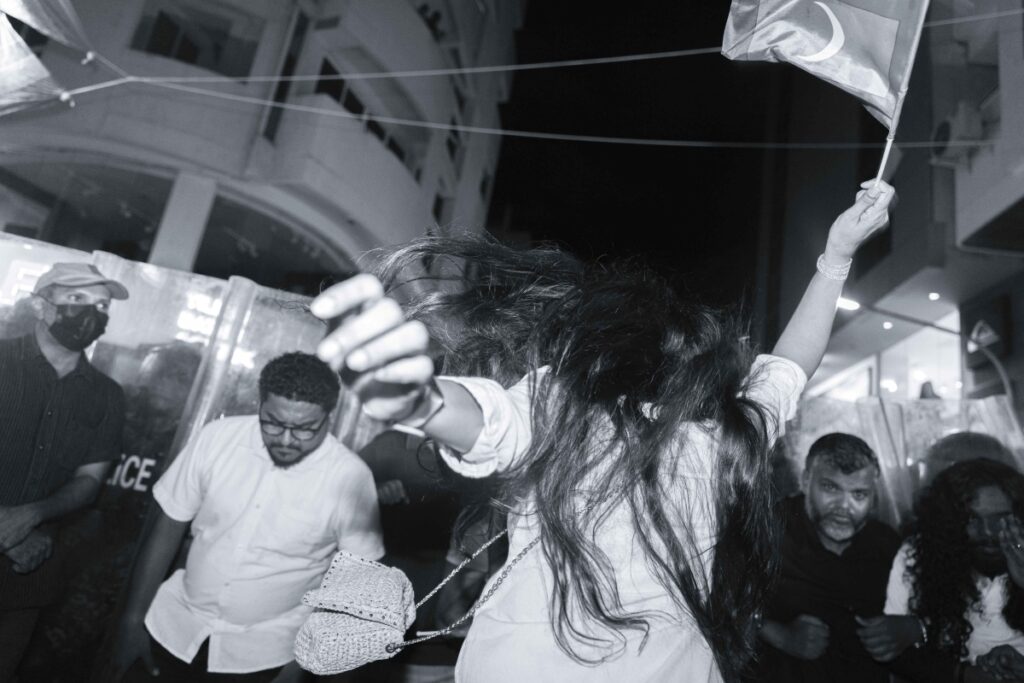
There was a ‘Lootuvaifi’ (‘Stop the Looting’) protest against the Maldivian Government in Male’ on Friday evening, organised by the opposition MDP party. Over 2,500 Maldivians attended, which is a lot by Maldivian standards. The demonstration was about a number of issues that members of the public have become frustrated with, including the leaked Adeeb Files, constitutional amendments and a crackdown on media freedom.
Hundreds of riot police rerouted traffic and set up barricades. Military drones circled overhead. Maldivian police arrested eight protestors and have been criticised for deploying tear gas as well as sonic weapons on protestors, for the first time in the Maldives.
Are more protests planned?
There was going to be another protest about this matter on November 17th unless the government met the MDP’s demands. However, it was cancelled. Protests aren’t uncommon in Male’, though – see below.
Is it unusual to see protests in Male’?
Not particularly. It’s fairly common to see Maldivians exercising their democratic right to protest in Male’ over a wide range of issues. The majority of the rallies and demonstrations are normally peaceful. However, this was one of the largest protests Male’ had seen for a while.
How do protests affect travellers?
Most protests are highly unlikely to affect the vast majority of travellers. They are normally contained in Male’, the capital city, which is on an island of its own.
The majority of international visitors never set foot in Male’. That’s because their arrival point, Velana International Airport, is not located in the capital city. The Maldives’ international airport is on an island named Hulhule, which is adjacent to Male’. There is no reason for the protestors to go to the airport island, because the target of their protests is the central government in Male’.
Velana International Airport is sometimes incorrectly referred to as Male’ Airport, and its airport code is MLE, an abbreviation of Male’. But there is no airport in Male’.
When guests depart for their resorts via speedboats, seaplanes and domestic flights, their departure point is the same island that Velana International Airport is located on.
What if I’ve got a layover, city tour, or need to catch a boat from Male’?
Even if there happens to be a protest in Male’, they normally won’t affect tourists. The situation in October was somewhat of a one-off due to the scale of the protest. And Maldivians know how important tourists are to their economy, as well as the fact that they’ve got nothing to do with their domestic politics.
Overall, only a small number of people visiting the Maldives decide to stay overnight in Male’ (normally on layovers). Sometimes visitors need to go to Male’ to catch a public ferry sailing to an inhabited island, such as Maafushi. And sometimes travellers take a Male’ Half Day Tour if they’re staying in a resort or guesthouse in Male’ Atoll.
Guided tours
With the November protest cancelled, there’s no need to cancel guided tours. The main reason there could have been for avoiding Male’ on November 17th was because the majority of the city’s attractions are located on the eastern side of the island (where the protest was going to take place), so roads might have been clogged or blocked.
Boat transfers
Many speedboat services working in partnership with guesthouses now offer pick-ups and drop-offs at the airport island. No major protests are currently planned now, but if you’d prefer to steer clear of the city anyway, you can check with your guesthouse to see if you can board and disembark in Hulhumale, rather than going to Male’.
If the speedboat or public ferry service you need only departs from Male’, your best option on a major protest day would have been to take a taxi directly from Velana International Airport via the Sinamale Bridge to the ferry terminal. If the departure point you need is Jetty 6 or the Main Ferry Terminal in the northeast of Male’, you could have been affected by road diversions and closures if there was another major protest, but that now seems unlikely. That’s because the protest was planned to take place in the area around the Artificial Beach area on the eastern side of Male’. That’s where the majority of protests and rallies are held.
At the demonstration on October 3rd, protestors attempted to march along Majeedhee Magu as well (the main shopping street), which is where there was an almost three-hour standoff with riot police.
Vilingili Ferry Terminal is unlikely to ever be affected by any protests because it’s away from Male’s main hub, which is on the opposite side of the island.
Layovers
The protestors in Male’ have no interest in tourists. However, travellers are typically advised by their foreign offices to avoid any protests, anywhere. If you were staying in one of the larger hotels on the east side of Male’ on the day of the October protests, it’s possible you could have been affected by the noise and maybe even tear gas, which was deployed by police. A small amount can seep through windows even when they are closed, depending on the wind direction.
If you’re concerned about staying in Male’, you could consider changing your hotel to one in Hulhumale inhabited island (joined by causeway to the airport island), Villingili inhabited island (the opposite side of Male’ from the airport island) or even a local resort such as Sheraton Maldives Full Moon Resort, Kurumba Maldives or Adaaran Prestige Vadoo. However, at this time, there does not seem to be any major cause for concern.
Key takeaways
The next large protest in Male’ was scheduled to take place over one day on November 17th. It was unlikely to affect the majority of visitors coming to the Maldives anyway, as it was only going to take place in Male’ city. Those arriving and departing via Velana International Airport would not have been affected because it’s on a separate island.
It’s always a good idea to familiarise yourself with your country’s foreign office advice for travellers visiting the Maldives so you can understand the risk factors in context and recognise the difference for yourself between a small update and a much more significant change.
About the Author