While both regions are stunning, there are some major differences between the Maldives resort experience and Caribbean holidays
One of the questions I’m frequently asked is, ‘What is the difference between the Maldives and the Caribbean?’. This question commonly comes from Americans, although a fair number of Europeans who have never been to the Maldives are also unsure of the major differences between the two.
It’s an important question when you’re trying to weigh up the pros and cons. Having been lucky enough to live both in the Maldives and in the Caribbean (including working remotely from Curacao and bouncing around the Mexican Caribbean), I’m going to give you the lowdown.
I absolutely love both regions, but since you’re reading Manta Media Maldives, I’m going to assume you’re probably leaning towards the Maldives!
1 – The Maldives has more private island resorts than the Caribbean
I crunched the numbers, and it’s true: The Maldives has 200 resort islands, which is more private island resorts than all the countries in the Caribbean put together (about a dozen in total).
2 – There’s only one resort per island in the Maldives
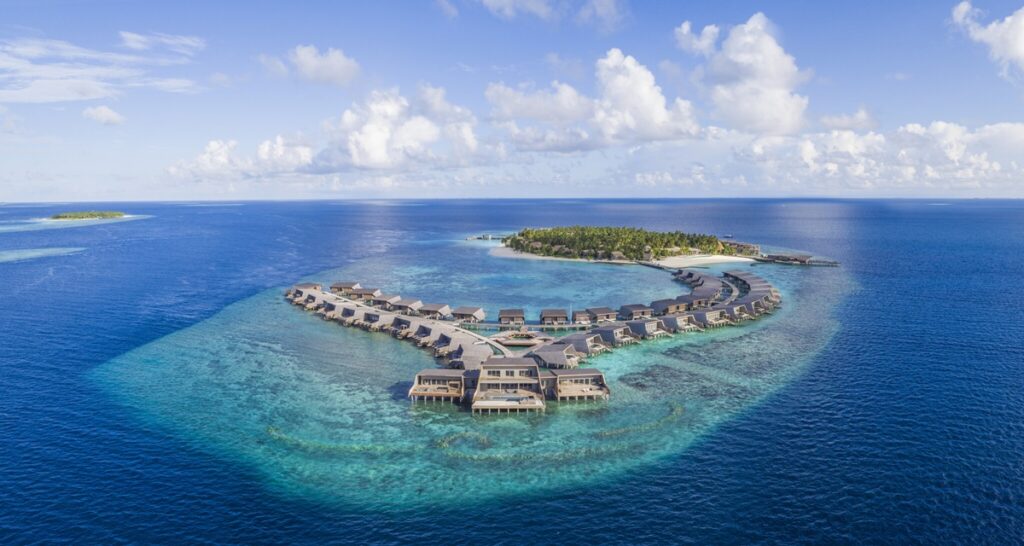
Only one resort is allowed to be built per island in the Maldives. The only exception is the Crossroads marina complex. This means each resort is on a private island of its own, with its own restaurants, boutiques and activity centres. No one can have access unless they are a guest or staff.
By contrast, the Caribbean does not have the ‘one island, one resort‘ rule. Most resorts in the Caribbean are blended in with (or at least are not too far from) a village or town. This also means they are usually within walking distance of other resorts and hotels.
3 – The Caribbean is a collection of countries in one region, but the Maldives, as an entire archipelago, is a sovereign state
The Caribbean is a collection of 13 different sovereign states plus several other territories. In fact, there are six official languages and many other dialects and unofficial languages in the Caribbean.
By contrast, the Republic of the Maldives is one country that’s made up of almost 1,200 islands. There is only one official language, Dhivehi, although English is widely spoken. And the original settlers of the Maldives are thought to be a mix of sailors, pirates, traders and shipwreck survivors. They eventually formed their own distinctive culture and nation.
4 – Maldivian towns and villages are on separate islands
Almost every resort in the Maldives is on its own private island, but the Maldivian population lives separately on 186 inhabited islands. These towns and villages are where you’ll find guest houses. Guest houses in the Maldives are often more like boutique hotels than youth hostels. The main advantage is you can mix with the local community and see what living in the Maldives is like. The cost (around $50-150/night) is another advantage.
Side note: If you want the ‘resort experience’ and can push your budget a little higher, you’ll be able to find good value resorts in the Maldives for under £290/$380 per night. Admittedly, a villa for around $200 is still a lot of money for many people, but in the Maldives, that’s considered a good rate for a 3 or 4-star. It would have been almost impossible to find any Maldives villa for that price 15 years ago, but prices have been coming down in recent years.
Wherever you stay in the Caribbean you’re normally within a short walking distance or driving distance of a community and its amenities. That means it’s easier to experience the authentic culture in the Caribbean than if you are stuck on a resort in the Maldives. However, if your major motivation is extreme privacy, the Maldives is hard to beat.
5- You usually stay at one resort for your entire Maldives holiday
Many first-timers don’t realise that in the Maldives the majority of guests stay on their chosen resort island for the duration of their holiday. That’s why choosing the right resort in the Maldives is so important. By contrast, in the Caribbean, you can wander off and check out other towns, restaurants and beaches.
The main reason for staying static is the cost of private transfers in the Maldives. They normally start at $200. So, if you want to visit a neighboring island or a restaurant that isn’t part of your resort, be ready to part with a lot of cash. You’ll also need to get permission from the other resort in advance (you can’t just turn up).
6- The islands in the Maldives are much smaller than the Caribbean islands
Again, people who haven’t been to the Maldives before often don’t realise the islands are tiny. By tiny, I mean an average of 0.3 to 0.7 square miles in size.
However, in the Caribbean, islands can be as big as 40,000 square miles (Cuba). That means most of the Caribbean islands are huge by Maldivian standards.
So, if you think you’ll get cabin fever, consider one of the larger Maldivian islands. And if you think you won’t handle it, try a gorgeous, larger island with luxury properties on it, like St Lucia, instead.
While some islands in the Maldives (like Taj Exotica) are so tiny you can see the beach on each side of the island just by moving your head, some people love that. But there are also bigger islands available that genuinely do feel more spacious despite their relatively small size, like JA Manafaru Resort.
It’s big enough for tennis courts and a nice running track around the edge of the island. There’s also a lot of thick jungle and majestic banyan trees covering a large portion of the island, which isn’t something to take for granted in the Maldives…Some developers rip all the trees and vegetation out during construction, so you feel like you’re roasting in a barren desert.
7 – Water villas are standard in the Maldives
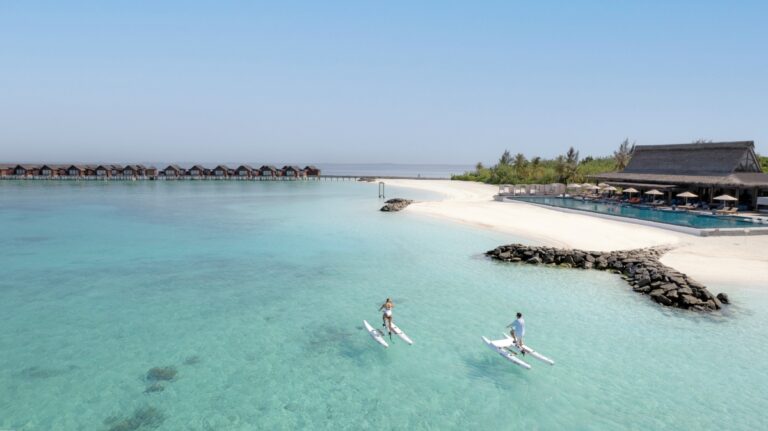
Water villas are still a fairly new development in the Caribbean. But there have been water villas in the Maldives since 1986. The concept of water villas for tourists is thought to have been imported to the Maldives from French Polynesia.
According to data from the Maldivian tourist board, around 85% of resorts in the Maldives have water villas.
By comparison, only nine different countries in the Caribbean have water villas. Large beach hotels are the most common accommodation option instead.
8 – The Maldives has even clearer water than the Caribbean, on average
You’ve booked yourself a Maldivian water villa and you’re just about to plunge into the resort’s lagoon from your private sundeck. So, what’s the visibility going to be like? By this, I mean the clarity of water and distance you can see through it. Well, the average visibility in the Maldives is 20-50 metres (65ft-164ft).
That’s compared to an average visibility of 18-30 metres (60-100ft) in the Caribbean. You might not know how clear the water is until you get there, unless you Google it and find diving reports. That’s because many tropical destinations like the Caribbean have turquoise water, but it can be cloudy-looking when you actually get into it.
It’s standard in the Maldives to have turquoise water so clear it’s almost like glass. This is partly because the Maldvian islands are made of coral and soil is scarce. So, there’s very little agricultural run-off and very little sediment to cloud the water, not to mention a lower population. There are 44,565,287 people living in the Caribbean versus 529, 072 in the Maldives.
About the Author