Rare sighting at Kandooma Thila in South Malé Atoll
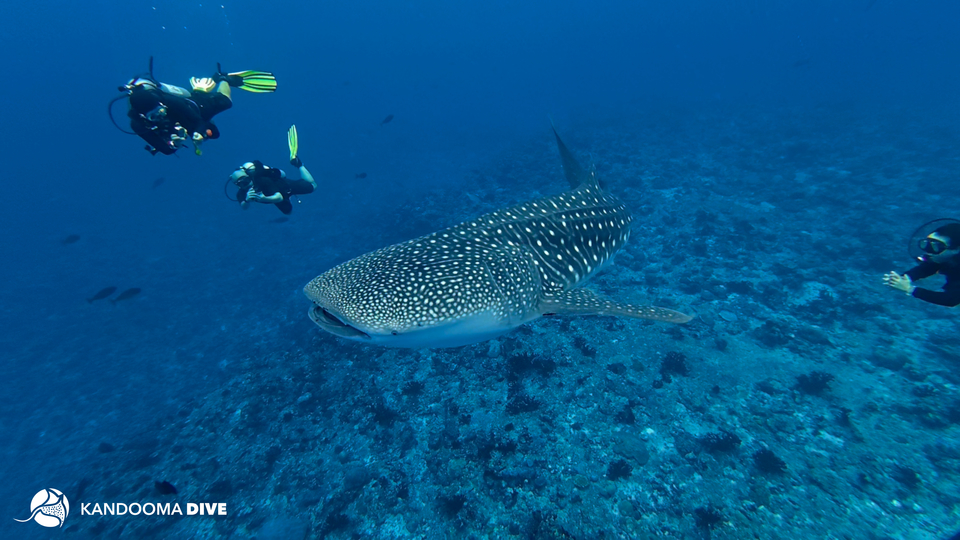
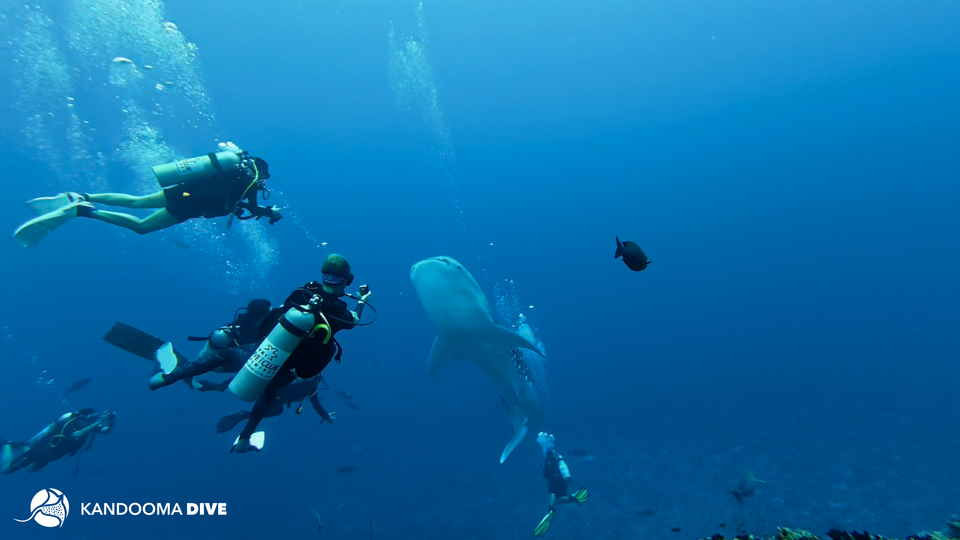
A dive group from Holiday Inn Resort Kandooma Maldives was lucky enough to capture these images when they had an unexpected encounter with a six metre-long (19ft) whale shark in South Male’ Atoll. The ‘biggest fish in the ocean‘ swam alongside them for more than half an hour before disappearing into the blue.
Whale shark sightings are rare in Male’ Atoll. These gentle filter-feeders are more commonly associated with the world-famous sites of South Ari Atoll Marine Protected Area (approximately 45 miles southwest of South Male’ Atoll), and Hanifaru Bay in Baa Atoll.
The unusual sighting took place at Kandooma Thila, a popular dive site in South Malé Atoll. It’s renowned for its teardrop-shaped underwater pinnacle (or thila), beautiful soft corals, and an abundance of pelagic life, including a grey reef shark cleaning station. This particular site is only recommended for Advanced and Nitrox-certified divers due to notoriously strong, unpredictable currents.
The manager of Holiday Inn Kandooma’s PADI Five-Star Dive Centre, Ibrahim Shaan, was leading a group of guests on the dive when they spotted the gentle giant. “We were diving at Kandooma Thila and were incredibly fortunate to encounter a magnificent whale shark of approximately six metres in length,” said Ibrahim. “The whale shark swam gently into the dive site, circled calmly alongside the divers, and stayed with us for more than half an hour. In all my years diving here, it was one of the most memorable experiences I have witnessed underwater.”
The divers shared their images with the Maldives Whale Shark Research Programme (MWSRP) in the hope that it could be identified. The Maldivian NGO encourages divers across the Maldives to become ‘citizen scientists’ by sharing images and details about whale shark encounters via its Big Fish Network.
This helps the MWSRP’s research team track their regional migration patterns, growth rates, and behaviour. The conservation group also helps to increase awareness and campaign for the appropriate stewardship of these magnificent creatures. Based on its size, they estimated the whale shark to be a juvenile aged approximately between eight and 15 years old.
It is thought that the Kandooma Thila sighting (which took place in April) may have been linked to a broader migratory movement although the creature may have been feeding opportunistically. Experts assume it was probably following plankton blooms or possibly baitfish. The Maldives is one of the only places in the world with a year-round population of whale sharks.
“We are very excited to be able to contribute meaningful observations, photographs, and video footage to the MWSRP,” said Sharon Garrett, Holiday Inn Kandooma’s director of marketing & sustainability.
“Each whale shark has a unique spot pattern behind its gills and along its flanks, almost like a fingerprint. By comparing those markings, along with any visible scars or identifying features, researchers can determine whether this individual has been recorded previously in the Maldives.”
Sharon added that whale sharks can also provide important indicators about the wider marine environment. “We know whale sharks are highly sensitive to ocean temperatures and food availability. Changes in their movement patterns may help researchers better understand larger ecosystem shifts taking place within our oceans,” she added.
The surprising nature of the sighting made the encounter even more special for the guests and dive team alike.
Holiday Inn Resort Kandooma Maldives is recognised as a leading dive resort in the Maldives. The resort’s Dive Free programme includes up to two complimentary scuba dives per day for up to two certified divers per villa (for guests staying three nights or more). For more information about Holiday Inn Resort Kandooma Maldives, visit www.maldives.holidayinnresorts.com.
You may also be interested in: VIDEO: Conservation NGO identifies 800th whale shark in the Maldives
About the Author