From dhonis to house reefs: Words and terms to help you decode your Maldives holiday
If you’re planning a holiday in the Maldives for the first time, you might encounter some words and terms that you’re unfamiliar with being used to describe experiences, places, and items.
Some of these might be Dhivehi words (the Maldivian language). However, others will be in your own language but still might not make sense without the context. Here’s a quick and easy guide to the most common terms used in relation to holidays in the Maldives:
Atoll
The word ‘atoll’ is the only word in the Maldivian language to be used in other languages around the world too. There are 26 atolls in the Maldives. They are all roughly oval or ring-shaped and are typically about 30 miles (50km) long and 18 miles (30km) wide. Each atoll has a natural coral and stone rim around the perimeter. And inside each atoll is what’s known as the ‘atoll lagoon’ plus a collection of islands (many of which will also have their own lagoons, too).
Think of each atoll kind of like a small county. The atolls are roughly grouped into regions – the northern atolls, the central atolls, and the southern atolls.
Every atoll has two names, the administrative atoll name and the geographic or traditional name. Most resorts and guesthouses use the administrative name of the atoll.
Bodu beru
The most famous form of traditional drumming and dancing in the Maldives. Bodu means ‘big’ and beru means ‘drum’. Bodu beru is usually performed by a group of 15-20 people. It’s thought to have been introduced to the Maldives by sailors and traders from East Africa, some of whom settled in the Maldives, centuries ago.
Dhivehi
The national language of the Maldives. English is widely spoken across the Maldives, but on some of the most far-flung islands, some Maldivians might not speak any English nor other languages other than their own. If you’re staying on an inhabited island, try to learn some Dhivehi words and phrases to be polite and show respect for your host community.
Most resorts have staff who speak languages from their main tourism markets, such as English, Chinese, Italian, and Russian.
Dhoni
A traditional Maldivian sailing vessel with a distinctive curved hull. They were originally carved from a single coconut palm log but today they can be made from wood or fibreglass. Dhonis are often used for resort and guesthouse excursions (like snorkelling trips) or to shuttle divers to a dive site.
Ferry
When the word ‘ferry’ is used in the Maldives, it refers to the public ferry service that connects many of the inhabited islands. There is also an inter-atoll ferry service connecting some of the atolls. Public ferries are slow but cheap. However, they never serve resort islands – you must take a transfer booked through the resort to get to a resort island. If you’re planning on staying in a guesthouse, you can read our guide to island-hopping in the Maldives by ferry here.
Guesthouse
Everyone knows what a guesthouse is, but in the Maldives the word is used more broadly than in other countries. It generally describes any type of tourist accommodation with multiple rooms that isn’t a resort. So, in the Maldives, a guesthouse can be a high-end $200 per night hotel with a spa, but it can also mean a $50 per night room, whereas in other countries a guesthouse usually only refers to budget accommodation.
However, guesthouses in the Maldives are always located on inhabited islands, whereas resorts are only ever located on a specific category of island that’s classed simply as a ‘resort island’. The difference is important because there are different laws on each type of island. On local islands, alcohol is banned and skimpy swimwear is also banned, because these islands are part of the Maldivian community. No Maldivians live on resort islands, and there’s only one resort per island (except at Crossroads).
House reef
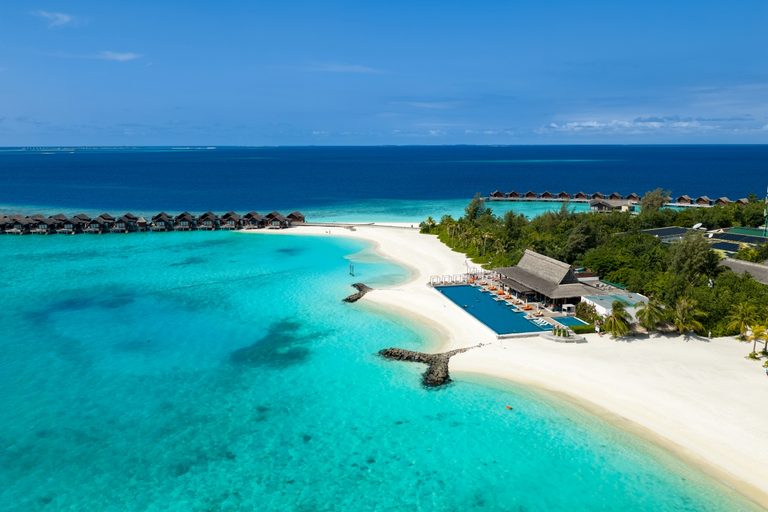
This is the reef adjacent to an island, which you can usually access easily from the shore by swimming or snorkelling a short distance. Not every island has a house reef, but most of them do. Water villas are very often located above, or close to, a house reef.
If you’re into snorkelling or diving, check reviews online to see if the island you’re planning to stay on has a good house reef.
Inhabited island
This is an island with a Maldivian town or village on it. There are almost 200 inhabited islands in the Maldives. In most cases, there’s only one settlement per island, because the islands are so small. On this type of island, you can find guesthouses (ranging from affordable to luxury), but never any resorts. Because of the Maldivians’ religious beliefs, alcohol is banned on inhabited islands, and so is skimpy swimwear.
You are also encouraged to cover your shoulders and chest on inhabited islands if you’re female. A simple workaround is by wearing a cotton bolero over your shoulders or a scarf made of light material. And women can cover up on the beach with board shorts and a rash shirt. (We love Lanala Swimwear‘s eco-friendly and Maldivian-inspired rash shirts! You can buy them in the Maldives or even arrange for them to be sent to you).
Men are not allowed to wear extremely short swimming trunks on the beaches and should not walk around the towns or villages without a shirt. No one should wear swimwear in the towns and villages as it offends many Maldivians to do so, so save it for the beach!
If the alcohol ban sounds like a turn-off but you want to experience an immersive, cultural holiday on an inhabited island in the Maldives, pick one of the few islands that have a ‘floating bar’ moored adjacent to it for tourists, like Dhiffushi. Please be aware that the floating bar moored off Maafushi was severely damaged in storms recently (September 2026).
Lagoon
We probably all know what a lagoon is, but when you’re surrounded by sea in all directions, can you still tell which part is the lagoon? The water you’re looking at might not all be a lagoon, at least, not on every single side of your island. As a general rule, the lagoon is the calmest and shallowest part of the sea and is ringed by a natural wall (which you may be able to see the outline of from the shore).
Sometimes, an island can be completely encircled by a lagoon. In this case, there’s normally pretty turquoise water all around the island. But sometimes parts of the island face the open sea, or a channel, too. That means darker, deeper, faster-flowing water. Sometimes big waves crash on the beach on the open ocean side of the island, and sometimes those waves are surfable.
If you’re on a resort island, typically water villas are located in the lagoon, where the sea is calmer.
An atoll itself is actually a massive lagoon. So the lagoon around your island is technically a lagoon within a lagoon.
Local island
See ‘inhabited island’ – it’s just another term for the same thing.
Picnic island
This is another category of island defined by Maldivian law as an island that is neither a resort island nor an inhabited island. They’re basically like mini national parks. People can visit them on day trips, have a swim and enjoy a picnic or BBQ. But you must leave them at the end of the day.
Resort island
This type of island is self-explanatory, but it’s also another legal way of classifying what sort of island it is. By law, only one resort is allowed per island in the Maldives (except at Crossroads). No towns or villages can be built on a resort island. So, the only people allowed to visit a resort island are guests with a booking, or staff. This ensures these private islands stay private.
Legally, alcohol can only be purchased on resort islands or on safari boats. Since the island where the international airport is located is neither, alcohol cannot be consumed anywhere on the airport island (not even in the lounge). Check out our guide to the newly expanded and redesigned Velana International Airport.
Safari boat
A safari boat is the term for a liveaboard vessel in the Maldives. Most safari boats are for diving or surfing, but a few specialise in simply cruising around the atolls in luxury, such as White Pearl.
Safari boats are all-inclusive so they are a very good value way of seeing the Maldives. If you’re into scuba-diving, expect 3-4 dives per day, every day in different locations.
Sandbank
A sandbank is an island without any trees on it. They change shape according to the season and tide, and sometimes disappear completely for long periods. People staying in guesthouses who want to sunbathe in a bikini – or just to enjoy a change of scene – can often book a sandbank excursion through their guesthouse.
Transfer
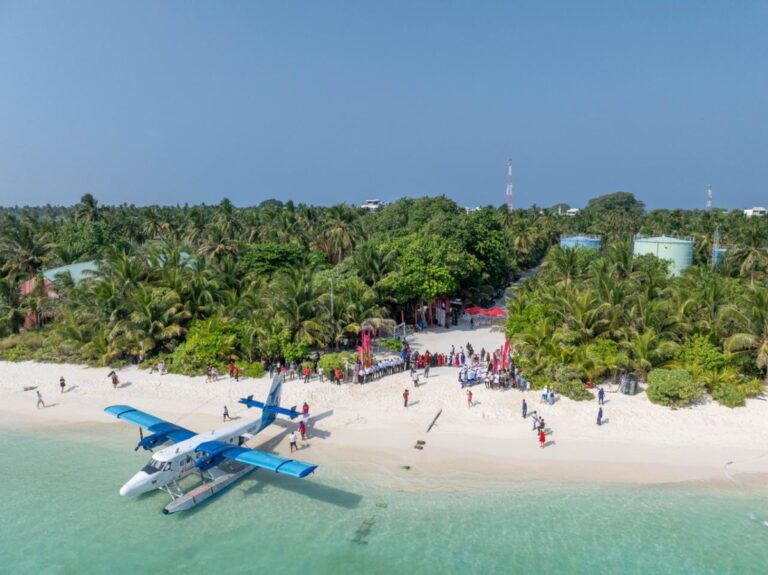
A transfer is the common term for your domestic transportation in the Maldives. Seaplane journeys, speedboat pickups, or domestic flights are all referred to as transfers. Most of the time they are booked by your resort or guesthouse for you.
Uninhabited island
There are almost 1,200 islands in the Maldives. Just under 200 are classed as inhabited islands, and around 200 are classed as resort islands. The remainder are uninhabited islands. This means they are islands without any towns, villages or tourist lodgings on them – just untouched jungle.
About the Author