Expert tips for cutting the cost of your Maldives getaway
As a Maldives specialist writer, one of the things I get asked the most is how to save money on a trip to the Maldives. That question is particularly pertinent this week, with news that the Maldives has been ranked the world’s fifth most expensive holiday destination, according to Squaremouth travel insurance. In case you were wondering, Greenland is the priciest, followed by the British Virgin Islands, French Polynesia and Antarctica.
Well, there are many different things you can do to reduce your holiday expenses. Below I’ve listed some of my top tips for anyone planning on staying in a resort in the Maldives.
Check your transfers
Before you finalise your choice of resort, check if transfers to and from the resort are included in the total price. Transfers used to be included as standard, but now several resorts (cheekily in my opinion) are tacking the cost on after you’ve booked, which can add as much as $700 USD per person to the booking.
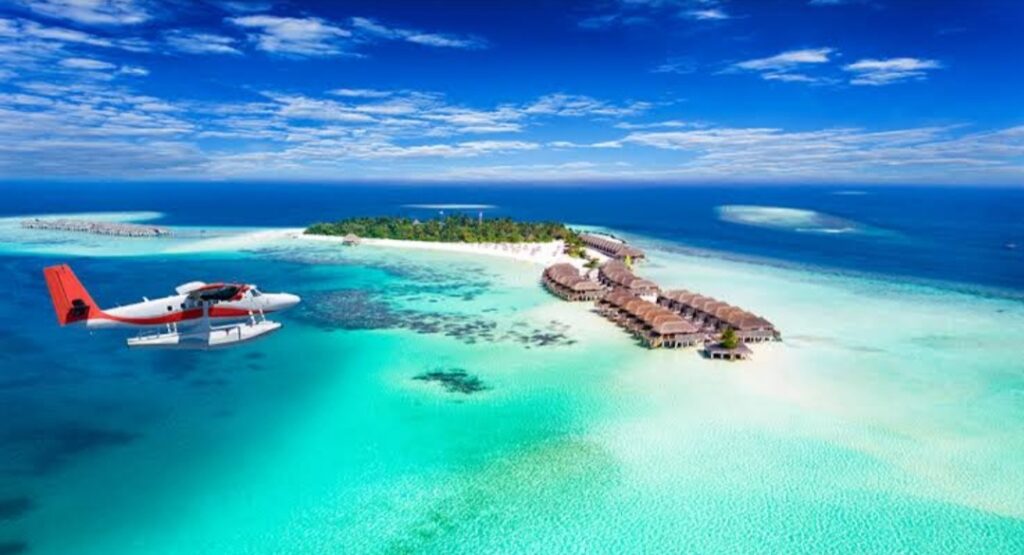
It may be cheaper to choose a resort in Male’ Atoll. Why do I say this? Well, because all resorts in Male’ Atoll are primarily served by speedboats, rather than seaplanes and domestic flights. The edge of the atoll is about as far as speedboats can go (about one hour of travel, maximum), so anything outside Male’ Atoll is served by a seaplane, or a flight to a domestic airport followed by a speedboat transfer. These flights tend to be much more expensive than speedboat transfers, which usually cost around $50-150 compared to several hundred dollars for a flight.
However, always look at the total cost of accommodation and anything else included in your booking as well, as you may still find a good deal for a resort outside of Male’ Atoll, which would balance out the cost of transfers. It’s just always worth checking in case a Male’ Atoll resort with speedboat transfers is cheaper.
Sign up for resort newsletters well in advance
While you can find some excellent deals through travel agents and with booking engines like Skyscanner, resorts sometimes have their own special discounts that you might not have heard about. Many resorts have newsletters offering discounts, special offers pages, or earlybird deals for direct bookings. You could save 30-50% this way.
The other advantage is that resorts, such as the Hardrock Hotel, often throw in additional perks for those who book directly with them, to thank them.
Search for ‘kids stay for free’
If you’re taking your children with you to the Maldives, search for resorts that allow kids to stay for free in order to save money. While this isn’t a common thing in the Maldives, a select number of resorts have special ‘kids stay free’ offers. They may only be available depending upon the time of year, although up to two kids under 12 can always stay for free at Anantara, anytime, if you book direct. Sometimes, as with Anantara, this offer even includes free meals for kids, as well.
While we’re on the topic of family holidays, its also worth checking if the resort you’re interested in has a kids’ club. JW Marriott resort in the Maldives has the largest, and it also has some of the latest kids’ club closing times in the country (9.30pm), so you can pop out for an essential date-night sunset dinner with your partner on one or two nights during your trip before you collect your children. This saves you the cost of paying for a babysitter (most kids clubs close by 5pm or 6pm).
The summer gamble
Summer in the Northern Hemisphere is low season in the Maldives, and it’s also when villa prices are lowest, so you can save money big time. But it doesn’t mean constant rain. As someone who lived full-time in the Maldives for five years (and who regularly spends long periods in the Maldives, even now), I’ve made many of my own observations during the southwest monsoon (April/May to October/November). It struck me in my first year after moving to the Maldives that even though it was monsoon season, we’d had days and days on end of non-stop sunshine.
Maldivians tell me the seasons have been unstable ever since the 2004 Indian Ocean tsunami, that’s why the wet season can be drier than it used to be, and the dry season wetter, with the beginning and end periods becoming more and more erratic. However, September is still the riskiest month, and according to recent data it’s definitely the wettest month in the Maldives.
But as for the rest of the southwest monsoon season, this is how it often plays out. It may rain, but only at night, or only after lunch (after being fine since sunrise). Or a short, very blustery storm may suddenly pop up, but the sky is clear again within a couple of hours. While you could be unlucky and find it rains for a few consecutive days or even a week, the longer your trip is, the lower the risk of experiencing many days of bad weather, one day after the other. If you are willing to take the risk in return for 50% off regular accommodation prices (or more), then it could pay off.
Consider all-inclusive
While my advice to consider an all-inclusive resort isn’t something exclusive only to the Maldives, the reason I recommend it is if you book bed and breakfast only, you could be shocked by just how much a lunchtime meal costs at a resort in the Maldives (around $40 USD for a main course at many resorts). And unlike with other destinations, even if the resort has a shop, you can’t buy food there to snack on, or to replace buying a lunch.
Plus (in case you haven’t visited the Maldives yet), you can’t ‘pop over’ from a resort to neighbouring islands to buy supplies, no matter how close they seem to be, because all the resort islands are private so there are no water taxis or public ferries between resort islands. The only option would be booking a private transfer for around $200 USD each way, which defeats the point of trying to save cash. You shouldn’t risk snorkelling to the next island either, as the super-strong currents between islands can be deadly.
So, if you plan on drinking every night, or are on a strict budget, don’t want ‘bill-shock’ when you leave’, or want to do lots of activities (they’re sometimes included in all-inclusive plans) take a look at a resort with a good all-inclusive option and try to calculate your average daily spending first. Some of the best all-inclusive plans include the Pullman Maldives Maamutaa, LUX* South Ari Atoll, and dusitD2 Feydhoo Maldives.
Bring sunscreen and toiletries with you
On a similar note to the above advice, don’t get caught out by how much it costs to buy anything in the resort shop. For example, you will get through a lot of sunscreen (you need it even just to walk to breakfast from your villa and back), but it costs 2-5 times (or more) than it would at home. The same goes for period products – I once paid $15USD for a small pack in an American-owned five-star resort in the Maldives (the same brand cost me $2.20 in the UK). Save money by bringing your own.
Bring your own snorkel gear
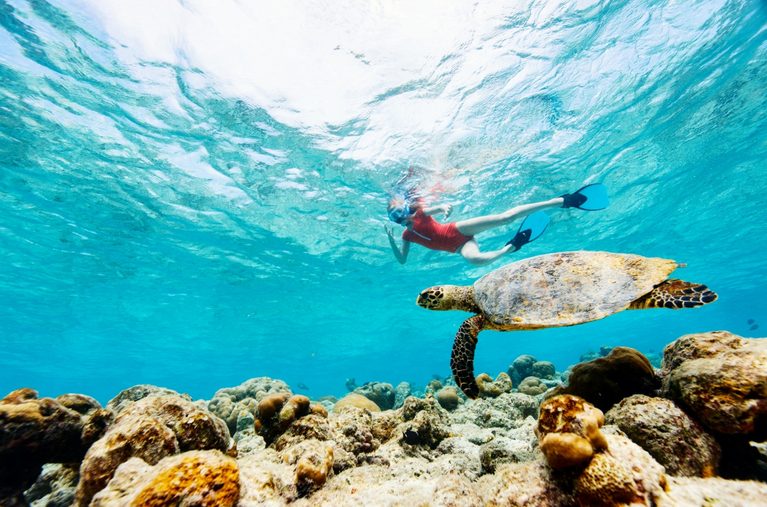
While all resorts offer snorkel gear for hire, some resorts charge you for it. As a general rule, most five-star resorts in the Maldives will loan you snorkel gear for free, but at many resorts that have four stars (and under), there’s a daily charge. And at one mid-range Spanish resort in the Maldives that I’m aware of, they charge by the hour – which is barely enough time to walk to the watersports centre, run into the sea, and back.
Considering that snorkelling is the number one activity in the Maldives, and how long the average guests spends snorkelling during their holiday, the cost can rack up very quickly. So, if you’re planning on snorkelling a lot, check with your resort to see if snorkelling gear is complimentary or not before you book it, or buy some quality snorkelling gear (like Cressi or Mares) in advance…Another benefit of this is knowing a hundred guests haven’t been chomping on the same snorkel as you!
You may also be interested in: What is Halloween like in the Maldives?
About the Author