A deep dive into the Navier Network and how guest transfers are changing in the Maldives
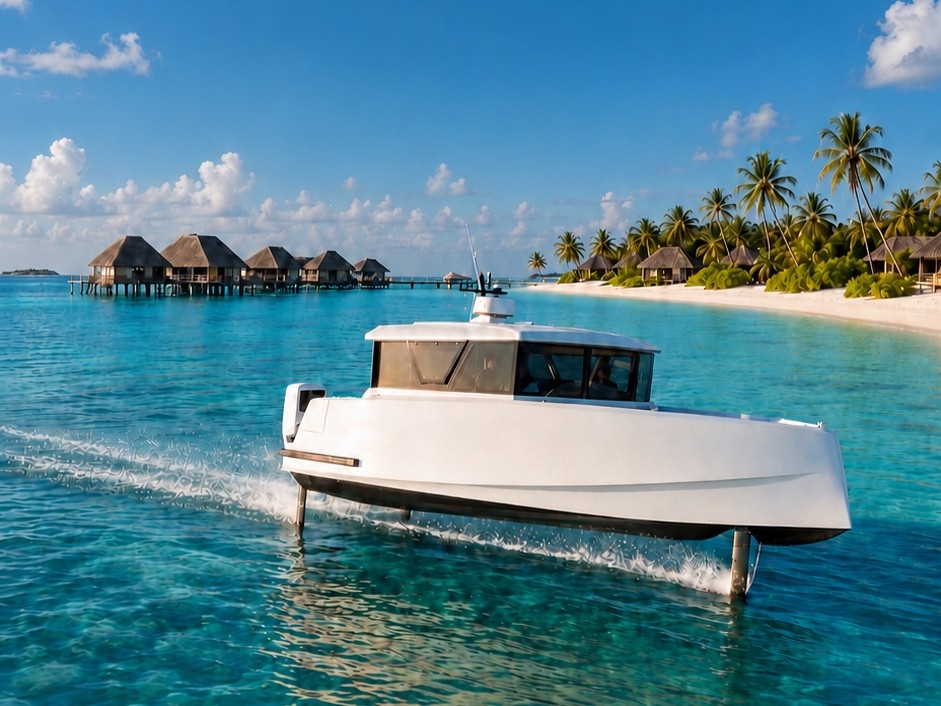
Since our report on how high oil prices triggered by the Iran War are spurring more interest in electric-powered Maldives resort transfers, another hydrofoil company has entered the race. The US-based maritime technology company, Navier, is teaming up with Dubai-based investment and development group, JIH Global, to create the Navier Network.
The Navier Network’s fleet of electric hydrofoils will connect resorts, airports, and local islands. Local islands are the Maldivian term for islands where Maldivians live and work, and are separate to resort islands. These are where you’ll also find guesthouses (30% of tourists stay in guesthouses on local islands).
Maldivian development company, HARIM Group, will lead on-the-ground setup of the Navier Network, including charging and operating infrastructure, route planning, resort partnerships, and network operations.
The rollout
The plan for the Navier Network is for 100 electric/hybrid vessels to be deployed in the Maldives over three years. The first five Navier N30 vessels will be rolled out this year in a pilot scheme. Then a further 95 will be deployed over the following two years. The total value of the fleet is approximately $100 million.
Founder and CEO of Navier, Sampriti Bhattacharyya, said: “The Maldives is one of the most important maritime transportation markets in the world. Nearly every guest, every worker, every resort, and every island depends on boats or seaplanes.
“That makes the Maldives the perfect place to prove that maritime transportation can be cleaner, quieter, standardized, software-driven, and dramatically better for the guest experience. We are not just deploying boats. We are building the first sustainable luxury transportation network on water”.
The design
Navier’s N30s are designed for high-end passenger transport. The air-conditioned cabins feature lounge seating, and Starlink connectivity. Guests will benefit from smoother journeys with reduced noise in comparison to speedboats. But what sets the Navier Network apart from any new electric hydrofoil project proposed so far in the Maldives to date is Navier’s software platform.
The new software platform will facilitate the Maldives’ first standardized electric inter-island transportation network. It will combine online bookings, digital dispatch, trip management, and all other fleet operations across the archipelago.
Network capabilities
Currently, the only other national inter-island maritime network comprises of the public ferries and speedboats operated by Maldives Transport and Contracting Company (MTCC). MTCC is a state-owned enterprise that links approximately 125 different islands across the Maldives. However, it’s not possible to book tickets via the MTCC website – passengers have to use third-party websites or purchase them from ferry ticket offices. And MTCC only covers local islands, not resort islands, whereas the Navier Network will cover both.
Since resorts (and many guesthouses) currently book transfers on behalf of their guests, it’s not yet clear whether the guest booking process will change or not for any islands serviced by the Navier Network.
Challenges and limitations
Even though they will be strategically placed around the Maldives, 100 vessels would not be enough – yet- to meet the demands of all the resort islands and local islands, nor to completely replace the hundreds of oil-powered resort transfer boats operating in the Maldives. But what the new Navier Network will achieve, with 100 vessels, is delivering the Maldives’ biggest and most unified investment in electric vessels to date. And it could be a test case for an even wider rollout.
The fleet of 100 Navier hydrofoils isn’t enough to cover all of the Maldives because there are around 400 resort islands and local islands and we estimate there are at least 1,000 speedboats currently servicing all the resorts in the Maldives, plus hundreds more servicing local islands.
Most of the 200 resort islands rely on boats for guest transfers, whether it’s for transportation between the airport and their island, or between a seaplane dropff jetty (or domestic airport) and their island. And each of these resort islands normally see multiple groups of tourists arriving at various times throughout the day. So that equates to hundreds of guest transfers at hundreds of locations each day all over the Maldives. Hundreds more additional speedboats run between local islands and airports or other inhabited islands.
This all means that transforming the Maldives’ gas-guzzling nationwide speedboat fleet into greener electric vessels will take more than 100 new hydrofoils. But with new arrivals announcing their entry to the market each month, perhaps the Maldives may eventually be celebrating an oil-free future – at least, when it comes to boat transfers.
About the Author